Time Budgeting and Time Mapping: How I Use a Flexible Approach to Stay On Top of All My Projects
How I use time budgeting and flexible time mapping to juggle multiple projects and interests without burning out (well…mostly). Practical tips for when life gets messy.

Key Takeaways
Juggling multiple passions, creative pursuits, work, life, or maybe even a portfolio career?
If you’re like me, you’re trying to do everything at once, spinning a dozen plates, feeling overwhelmed, and possibly guilty if you let one fall.
And the nagging question: How do I fit it all in without burning out?
The answer isn’t cramming more into our already busy day (although that doesn’t stop me from trying – or lying face-down on the floor, never feeling enough). So, what is the answer?
While I haven’t found the pot of gold under the rainbow, I have found a handful of time management techniques that help tame the overwhelm and find time to pursue all the things. Not because I want to hustle harder, but because they bring me joy.
Below, I’m sharing my current system – as imperfect as it is – that I use to juggle it all, creative work, paid work, life stuff, and everything in between.
Time Mapping, Budgeting, and Scheduling—What’s the Difference?
TBH, the jargon doesn’t really matter. Below, I’ll share exactly how I use different techniques to create a hybrid system that works for me.
That’s how most of us work best: take the techniques and suggestions and then rework them to suit our own circumstances.
So, what are these techniques? Here’s an outline of the time management techniques that can help juggle multiple projects and passions.
Time Budgeting: Basically, estimating how much time tasks will take (more on that below), and comparing that to the actual time you have available after sleep, work, eating – all that stuff. Just like a financial budget allocates a set amount of money, a time budget helps you allocate your time.
Time Mapping: This is a big picture look at how you want to use your time during the week or month. It helps you balance priorities and see where your time goes. A realistic time map needs to take into account your time budget and actual schedule.
Scheduling: This is assigning specific tasks to specific times in your calendar. Your dentist appointment, for example. It’s your actual plan for exactly when things happen. You can use a schedule to ‘book’ creative work, just like an appointment.
Time blocking: This means carving out chunks of time for different tasks. So you might have a ‘creative work’ block or ‘replying to emails’ time block. The goal is to keep similar tasks together and avoid time confetti and context switching, where your day is being chopped up into little bits and you have to spend time reorienting yourself.
Time boxing: This is where you set a strict time limit for a task – great for never-ending tasks like email that tend to expand to fill all available time. For example, I’ll set 20 minutes to answer emails, then move on to something else.
What does this all mean for the multi-passionate person?
While these are all productivity techniques, the point for us is NOT to squeeze more work, more productivity out of every hour and become a hyper-efficient robot (despite what billionaires might believe).
For the multi-passionate people and those juggling dozens of ideas, projects, and creative pursuits, it helps us reduce the overwhelm, carve out more time to explore new things, create breathing room, and make space for what matters.
Even just a little navel gazing without guilt (still working on that part).
It’s not about doing more. It’s about wasting less time and feeling less scattered while doing the things you care about.
Below, I explain how I use these techniques to be more intentional about my time.
Step 1: List Your Projects and Ongoing Tasks For the Month
Because I’m easily distracted by shiny things, I like to focus on just one month at a time.
Monthly blocks give me a bit more structure to balance all my priorities without locking me into them forever. It’s flexible, but there are guardrails too. The guardrails help me stay on track instead of getting overwhelmed.
And I can chase new ideas next month if I want to.
Some projects will naturally run longer than a month, but breaking them down into smaller, monthly chunks helps keep them moving forward.
Here’s a snapshot of my current projects:
- Writing for blog 1 (I break this down into specific articles)
- Pinterest scheduling for blog 1
- Writing for blog 2 (this one!)
- Creating a portfolio for my new business
- Writing a novel (up to 18,000 words as I write this!)
- Learning more in-depth skills with Canva
- Organising a plumber to fix our taps
- Picking paint colours to repaint the hallway
- Decluttering under the stairs
And on top of that, there’s the ongoing stuff:
- Paid freelance work
- Regular housework, parenting, dog care, life admin, appointments, kids’ activities…
- Volunteer work I do
- Reading
- Sewing a quilt
- Going to the gym (well…the intention is there, not so much the execution)
Is it a lot? I don’t know. I think, like many dilettantes, it never feels like enough. There’s always this nagging sense that I should be doing more, learning more, finishing more. But getting it out of my head and onto paper makes things feel less overwhelming.
Take the hallway painting project, for example. I’ve been low-key stressing about it for… three years now! But when I finally sat down, it took me 20 minutes to pick a paint colour and jot down a few recommended painters from our local FB community page.
That’s why it helps to write a list. Once I can see what’s on my plate, it’s not such a big, hairy, impossible task. I can start to figure out where (or if) everything fits.
The next step is to find time to slot each task and project into my month.

Step 2: Time Blindness – How Long Does Stuff Actually Take?
Time blindness is when you have trouble sensing, estimating, or planning around the passage of time.
While it’s linked to ADHD, everyone experiences time blindness sometimes, especially when it comes to scrolling social media (wow, I just spent three hours scrolling TikTok?) or underestimating how long a task will take.
It’s even more likely when you’ve never done the task before, or just haven’t stopped to think about how long it actually takes.
In order to fit your passions in and enjoy them, it helps – a LOT to know how long stuff takes, particularly the boring stuff like work, sleep, and housework.
When you have a rough idea of where your time goes, you can map out (see below) how to spend the remainder instead of just hoping there’s time left over.
I use Toggl to track my time. Not always, because I’m not that meticulous. But I do it fairly regularly to gauge how long tasks take.
Toggl is free to use, and you can put it on your mobile device to time how long it takes to do tasks that aren’t tied to a computer.
For my freelance work, I time ‘bum-on-seat’ focus time (actually doing the work) as well as how long it takes me to complete a project from beginning to end. Because interruptions. And brain breaks. And needing to hang the washing out while the sun shines.
I’ve found I consistently take double the focus time to finish a job. For example, if it’s one hour of focused deep work, it usually takes me two hours with breaks and interruptions. If I have insomnia, and only got three of hours sleep the night before, it’s x3 bum-on-seat time.
A blog post like this? Probably at least six hours. Or all day when I include taking the dog for a walk, and making lunch, and, ahem, scrolling Facebook.
Takeaway: things always take longer than I think they will, so it’s important to ‘budget’ that extra time.
I use this information not to force myself to be more ‘productive’. I use it to better plan my day. I better understand my limits and set better, more realistic boundaries between what I can and can’t fit in.

Step 3: Map My Month
This is where all of those time management techniques described above come together.
When you have an idea of:
- your projects
- how long stuff takes (time budget)
- your schedule (stuff you have to do)
Then you can work out where (or if) you can fit it in over the month.
For this, I use Google Calendar. We have a household calendar with work booked in, appointments, kids’ activities, family time, errands, etc. They are the big building blocks I have to work around.
From my schedule, I can see how much of my ‘time budget’ I have left.
There are 720 hours in a 30-day month. Once I subtract sleep, work, household, and health, I then work out how much time I have left for all my other projects.
The power of looking at this monthly (instead of daily) is that those scraps of time add up. One hour here, two hours there—it never feels like much.
But when I see that I have about 50-100 hours per month? That feels like a significant chunk of time.
For the busiest of us (25-55 years of age), average leisure time is around 4 hours a day in the US, a bit under 4 hours if you’re in the UK, and 4-5 hours for us laid-back Aussies.
So, if we utilise just two hours a day on our passions, that’s still 60 hours a month.
Two hours doesn’t feel like much.
Sixty hours? That’s a short course, half a novel draft, or a whole lotta guitar practice.
So, what’s the action step?
This is where I get out my calendar and my list of projects and tasks (along with the time estimates) and block in when I will get them done.
Two hours to schedule some pins? I have some time on Thursday night?
Six hours to write a blog post? I can spread that over three or four evenings. Or maybe a rainy Sunday.
In a single day, some of my projects will definitely be neglected. But over a month? I can find time to touch on most of them and move the needle, even if it’s just a little bit.
And if I don’t? There’s always next month.
Of course, some weeks blow up, and none of it happens. Because life!
But mapping out my time gives me something to come back to, instead of starting from chaos every day.
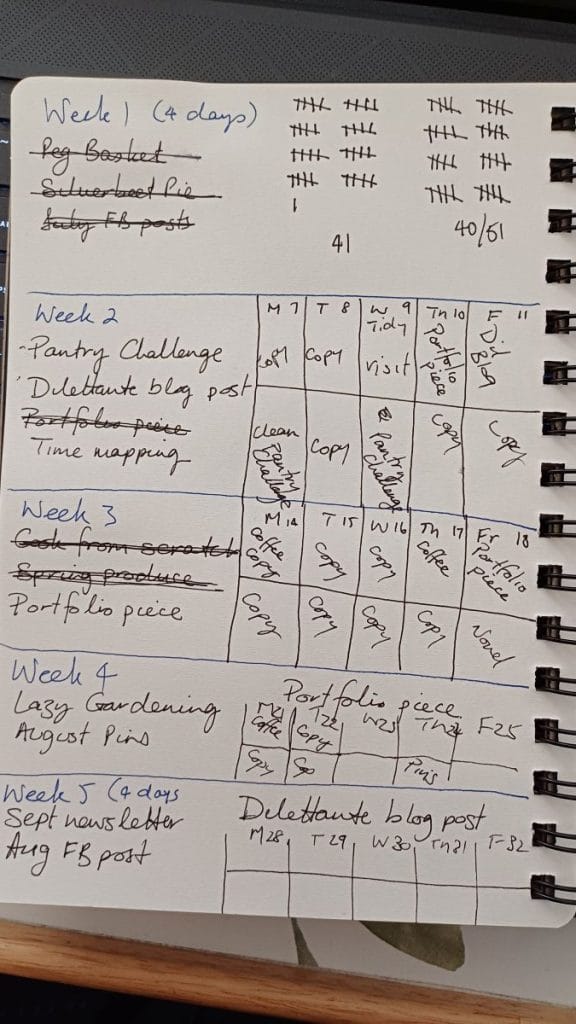
This is my rough plan for the month: a mix of client work, blog posts, creative projects, and biz. The check marks? That’s me distracted doing YouTube quizzes and pretending it’s learning.
Step 4: Flex the Plan and Include Downtime
Here are three things I’ve learned that are critical for avoiding burnout.
1. Make the plan flexible.
Because sometimes you’re exhausted. Or a friend invites you out for coffee. Or your brain just says Netflix. That’s life. These are passion projects, not deadlines from your boss – it’s okay to let things slide.
2. Plan plenty of downtime.
We all need time to stare out the window, go for a walk, chat to a friend, or give the dog some scritches (Mine will crawl onto my laptop if I ignore her long enough.) While scheduling my time helps me feel in control, trying to fill every hour is a guaranteed recipe for failure.
3. Add buffer time to everything.
If I think something will take one hour, I block out two. PLUS downtime. Because the reality is: there will be interruptions. Brain fog. Laundry. Scrolling. Sudden urges to reorganise the pantry. Adding breathing room into each task means I’m far more likely to follow through—and feel good doing it.
Step 5: Review and Redo
Every time I try something, I learn. So, each month I adapt the plan. Also, life changes, and I find that plans that work perfectly in one season (or week) don’t work in another.
So at the end of the month, I review what works, what doesn’t and try to adjust in the next month.
For me, the hardest part of this is staying flexible. As a freelancer, work often lands in my inbox with zero notice and on a tight turnaround. That means I have to rejig my plan on a day-to-day basis.
So while I like to review and reset monthly, in practice? In reality, it’s daily or weekly.
If you’re multi-passionate, your ‘want-to-do’ list is probably a mile long and you’re probably trying to juggle a dozen things on top of everyday life.
These time management techniques aren’t about hustle culture or trying to squeeze more productivity out of your day.
What they can do is help give time to ALL the projects and reduce overwhelm and the guilt that comes with wanting to do everything. Yesterday.
By mapping your month, budgeting your time, and adjusting as you go, you can build a system that serves your deliciously clever, creative, and curious mind.